
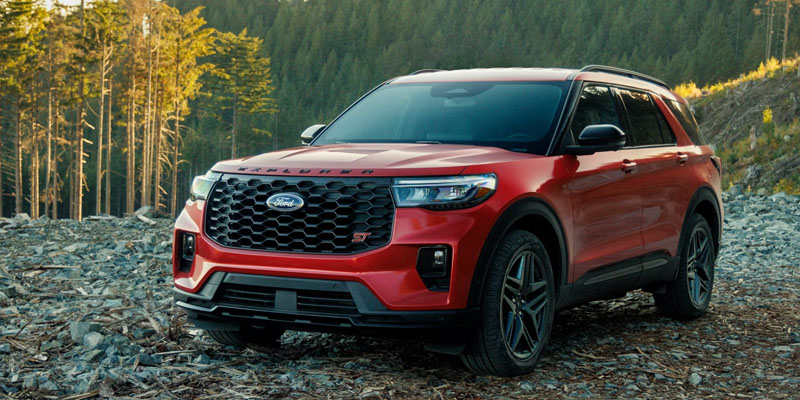
The Ford Explorer Active is one of the more specific trim choices in the lineup. Shoppers who encounter it while comparing models often want a simple answer: what is it actually for? Unlike the ST-Line, which signals sport styling, the Active does not always communicate its purpose through its name. This blog explains what the Explorer Active is. It also covers how it compares to the XLT and ST-Line, whether all-wheel drive is standard, and which buyers the trim was configured to serve.
What the Ford Explorer Active Actually Is
The Explorer Active is a mid-tier trim positioned above the XLT. Ford built it around a clear orientation: a family SUV with outdoor-ready equipment and a rugged visual presence. However, it does not move into dedicated off-road territory. The Active sits between a standard family configuration and a vehicle set up for regular outdoor use.
That orientation shows up directly in the trim’s physical setup. The Active rides on a slightly raised suspension, which adds ground clearance over lower trims. Additionally, the exterior uses darker accents, standard roof rails, and Active-specific badging. These are not purely cosmetic choices. They reflect a trim configured for buyers who use their SUV beyond commuting and school pickups.
Furthermore, the Active does not sacrifice passenger space for gear capacity. Seven-passenger seating is retained at this tier, which matters for families who need both. Because of that, Ford positions the Active as a complete package rather than a narrow specialization.
The standard Active configuration includes the following equipment:
- Raised ride height with increased ground clearance over the XLT
- Roof rails standard for cargo carriers, bike racks, and roof-mounted gear
- Exterior dark trim accents and Active-specific badging
- Standard all-wheel drive with no need to add it as an option
- Seven-passenger seating retained across the full trim
How the Active Differs From the ST-Line
The ST-Line and the Active sit at a similar price point. Because of that, the comparison between them is one of the most repeated questions in the Explorer trim search space. However, the answer is not about which trim is better. It is about which philosophy matches the buyer.
The ST-Line is a sport-influenced configuration. It takes visual cues from the Explorer ST, including a blacked-out grille and sport-tuned suspension. The suspension on the ST-Line is calibrated for flatter cornering and a firmer ride. Therefore, it suits drivers who prioritize on-road attitude and handling character.
The Active moves in the opposite direction. Where the ST-Line firms up the suspension for road use, the Active raises ride height and adds outdoor hardware. Roof rails support carriers, bike mounts, and kayak racks. Furthermore, the styling cues signal a different set of priorities than the ST-Line’s sport framing does.
Shoppers who haul gear, tow trailers, or load a roof rack will find the Active maps more directly to those activities. However, buyers who want sharper on-road driving feel will find the ST-Line better aligned. The two trims answer different versions of the same question.
Is AWD Standard on the Explorer Active?
Yes. All-wheel drive is standard on the Ford Explorer Active. This is one of the clearest differences between the Active and lower trims. On the XLT, AWD is available as an option. On the Active, it is already included. Therefore, buyers do not need to verify whether it was selected at the time of build.
The AWD setup is Ford’s Intelligent 4WD system. It monitors wheel slip and road conditions continuously. When the front wheels lose traction, the system shifts torque forward without driver input. Additionally, during normal dry-road driving, the system operates in rear-biased mode to preserve fuel efficiency.
For buyers in northern Indiana, where road conditions shift across seasons, this matters. Because AWD is built into the Active’s base price, there is no need to price out an XLT with AWD added separately. The Active simplifies that calculation entirely. Buyers who know they need AWD have a more straightforward starting point with the Active than with lower trims.
How the Active Compares to the XLT
The XLT is the Explorer’s volume trim. It covers a broad range of buyers who want a well-equipped family SUV without paying for features they will not use. However, understanding what the Active adds above the XLT is the clearest way to evaluate whether the step-up fits a specific buyer.
The Active brings three structural additions over the XLT. First, AWD is standard rather than optional. Second, the raised ride height and exterior setup shift the vehicle toward outdoor use. Third, the roof rail system adds cargo infrastructure the XLT does not include. Furthermore, the Active’s base price reflects all three of those additions already built in.
However, what the Active does not change is the powertrain, seating layout, or core tech package. A buyer stepping up from an XLT is not getting a more powerful engine. Because of that, the step-up is about configuration and use-case orientation rather than a wholesale upgrade across every dimension.
The key differences between the Active and XLT break down as follows:
- AWD standard on Active, priced as an optional upgrade on XLT
- Raised ride height and increased ground clearance on Active only
- Roof rails included as standard on Active, not available on XLT at base trim
- Dark exterior accents and Active-specific badging distinguish the two visually
- Base price difference reflects the AWD and outdoor-ready hardware already included
Who the Explorer Active Fits Best
The Active fits buyers who use their SUV across a range of activities. Families that load gear for camping, attach a bike rack, tow a small trailer, or drive in conditions where AWD adds measurable value will find the Active’s setup consistently relevant. Furthermore, buyers who want AWD included without the extra pricing step will find the Active simplifies the purchase decision.
However, the Active is not the right fit for every Explorer buyer. Shoppers who prioritize sport handling, have no use for roof-mounted cargo gear, or rarely encounter traction challenges will be better served by the ST-Line or the XLT. The Active fills a specific gap in the lineup. Therefore, recognizing whether that gap matches a buyer’s actual use pattern is the clearest path to the right trim decision.
Family Ford of Bluffton can walk buyers through the Active alongside the XLT and ST-Line. Because the differences between these trims come down to use case rather than pure spec, that conversation is often more useful than a side-by-side comparison chart alone.
Connect with us

