

Ford Explorer With Third Row Seating
Explore Ford Explorer Inventory in Bluffton
Talk With Our Team About the Right Explorer for Your Family
Schedule Your Ford Explorer Visit at Family Ford of Bluffton
| Sales | ||
| Day | Open | Closed |
| Monday | 8:00AM | 6:00PM |
| Tuesday | 8:00AM | 6:00PM |
| Wednesday | 8:00AM | 6:00PM |
| Thursday | 8:00AM | 6:00PM |
| Friday | 8:00AM | 6:00PM |
| Saturday | 9:00AM | 3:00PM |
| Sunday | Closed | Closed |
| lunch at noon -1pm | ||
See If the Ford Explorer Fits the Way Your Family Drives, Rides, and Packs for the Week
If you are looking at a Ford Explorer with third row seating, you are probably sorting through more than seat count. You are trying to judge whether one SUV can handle school mornings, grocery runs, weekend travel, growing kids, and the cargo that comes with all of it. That is where the Explorer earns serious attention, because it gives families a three row midsize layout without pushing them into a larger SUV right away.
That middle ground is what makes the Explorer worth a closer look. A smaller SUV can leave a family short on seats or short on storage, while a larger one can feel harder to park, heavier to manage, and larger than the household truly needs. The Explorer lands in a space families want. It offers three rows, seating for up to seven, and enough interior volume to support a busy weekly routine while still staying in the midsize class.
The right family SUV is rarely about one headline feature. It comes down to how the space works when real life fills it up. That means thinking about who sits in the third row, how often the cargo area needs to hold strollers, sports bags, or grocery runs, and whether the trim you choose matches the comfort and convenience your household will care about after the first week of ownership.
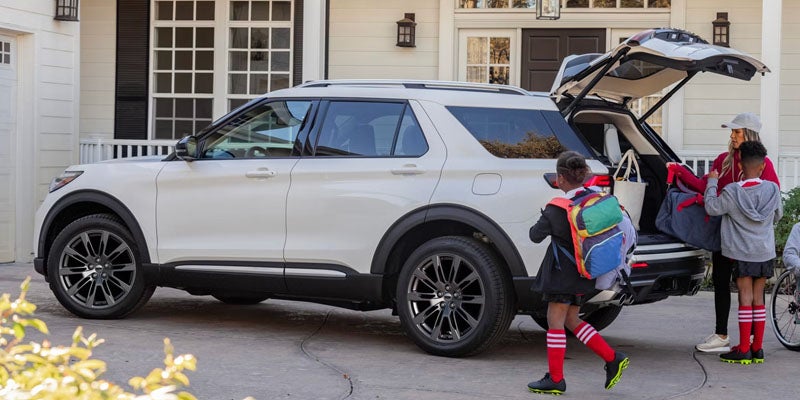
How Explorer size works for families
The Ford Explorer is a midsize SUV, and that classification matters because it shapes the whole decision. A midsize three row SUV gives families more room than a two row crossover without moving all the way into the footprint of a full size SUV. For parents who need seating depth but still want something manageable in parking lots, garages, and daily traffic, that balance is a major part of the Explorer story.
Official dimensions reinforce that role. The Explorer measures 198.7 inches long and has a 119.1 inch wheelbase, while maximum seating capacity reaches seven passengers. Passenger volume reaches 150.3 cubic feet on applicable models, which places it firmly in the part of the market families consider when they want more room without going to an Expedition sized vehicle.
That size creates an important decision tension. If your household needs three rows only part of the time, the Explorer can give you the extra seating you need without making every commute feel oversized. If you expect adults in the third row on a constant basis or need full cargo strength with every seat occupied on longer drives, that is where you may need to compare your expectations more carefully. The Explorer is appealing because it covers a wide family use case, but it still works best when the buyer is honest about how often every seat will be full at once.
What the third row means in day to day use
The Explorer answers the basic question clearly: yes, it is a three row SUV. Ford lists maximum seating capacity at seven, and all 2026 Explorer models have third row seating. That solves the first part of the family fit question, but the second part is the one that shapes satisfaction later. How usable is that third row in daily life.
The answer starts with who will use it. Third rows in midsize SUVs are often strongest for children, preteens, teens, carpool duty, relatives on shorter drives, or the extra passenger that turns a five seat cabin into something more useful. The Explorer fits that pattern. Ford lists 31.8 inches of third row leg room, along with 38.9 inches of head room, which gives families a usable back row but still keeps the vehicle within midsize dimensions.
This is why a test drive matters more than a spec table alone. A family with two younger children, a rotating school pickup schedule, and occasional extra passengers may find the Explorer hits the target cleanly. A household carrying tall teens or adults in the third row every day may want to judge entry, knee room, and comfort more critically before making the decision. The third row is a real strength, but the right evaluation is about frequency, passenger age, and trip length rather than checking a simple yes or no box.
Cargo room and passenger tradeoffs
Cargo space is where a family SUV either proves itself or starts forcing compromises. The Explorer offers 16.3 cubic feet behind the third row, 46 cubic feet behind the second row, and up to 85.8 cubic feet behind the first row on applicable models. Those numbers matter because they show how the SUV changes with your day. With every row in use, you still get a rear cargo area for smaller loads. Fold the third row, and the Explorer opens into a much more travel friendly setup.
For families, that means the Explorer works well when the household does not need every seat filled on every drive. In one part of the week, it can carry extra passengers for school, practice, or dinner plans. In another part, it can act much more like a roomy two row family hauler with enough space for strollers, luggage, or larger shopping trips. That versatility is the point. The vehicle can shift with the schedule instead of locking the family into one fixed layout.
The tradeoff is straightforward. When the third row stays up, cargo room becomes the area to study closely. Families who travel with a lot of bags, a large stroller, sports gear, or bulk shopping will want to picture those items in the load floor before deciding. Families who use the third row part time and fold it often may find the Explorer easier to live with because it gives them the extra seating when needed and stronger storage the rest of the time.
Which Explorer trims fit different family priorities
Trim choice changes the family fit conversation because seating layout, comfort, and convenience features can alter how the cabin works. The 2026 Explorer lineup includes Active 100A, Active, ST Line, Tremor, ST, and Platinum. The Active 100A includes a second row bench seat for seven passenger seating, while higher trims bring different mixes of audio, camera, comfort, and seat features.
That matters because families are not all looking for the same version of usefulness. Some will want the seating count and a simpler value focused setup. Others will care more about upgraded interior materials, cameras for parking, heated second row seats, or power folding third row seats. A family should compare trims by asking what will matter on a busy Tuesday, on a road trip, and over a full year of school runs and errands, not only what looks strongest on a feature list.
When to stay with Explorer and when to size up
The Explorer is often the right move when your family wants three rows without stepping into a full size SUV. It gives a useful middle lane between smaller crossovers and larger utilities, which is why it remains so relevant for growing households.
There is still a clear comparison point to keep in mind. If the third row will be used constantly by adults, or if your family expects full passenger loads and heavy cargo on a regular basis, a larger SUV may be worth considering. If your household needs a vehicle that can flex between daily commuting, school, errands, and periodic extra seating, the Explorer may cover that mix more cleanly while staying easier to manage around town.
Does the Ford Explorer have third row seating?
Yes. The Ford Explorer is a three row SUV, and Ford lists maximum seating capacity at seven. Families should still confirm the exact seating layout on the model they are considering so the cabin matches how many people they plan to carry most often.
Is the Ford Explorer a midsize SUV?
Yes. The Explorer sits in the midsize SUV class, which is a major reason families consider it when they want more room than a smaller crossover but do not want to move into a full size SUV right away.
Which Ford Explorer trim makes the most sense for family use?
That depends on what your family needs from the cabin. Some shoppers will care most about seating count and value, while others will place more weight on comfort features, parking cameras, upgraded sound, or power folding third row seats. Comparing trims by family routine is more useful than comparing badges alone.
How much cargo room does the Explorer have with the third row in use?
The Explorer offers 16.3 cubic feet of cargo room behind the third row. That can work well for lighter daily loads, while families carrying larger items more often may want to picture how often they would fold the third row and use the 46 cubic feet available behind the second row.
If the Explorer already makes sense on paper, the next step is seeing how the cabin works in person. Seat access, cargo layout, visibility, and second row movement are all easier to judge when you walk through them directly. That is how families move from broad interest into a decision they feel good about.
(Note: This article focuses on providing valuable information and does not mention specific pricing, for more information about financing and car buying, please reach out to our dealership.)