

Do you really need a Super Duty truck? For many truck shoppers comparing an F-150 to an F-250 or F-350, the answer often depends less on maximum towing numbers and more on how the truck will actually be used over time. Some drivers tow large campers, heavy trailers, or commercial equipment regularly, while others only haul recreational loads a few times per year. That distinction matters because Ford Super Duty trucks are engineered differently than lighter-duty trucks, and those differences affect towing stability, payload management, suspension behavior, daily driving, and long-term ownership experience.
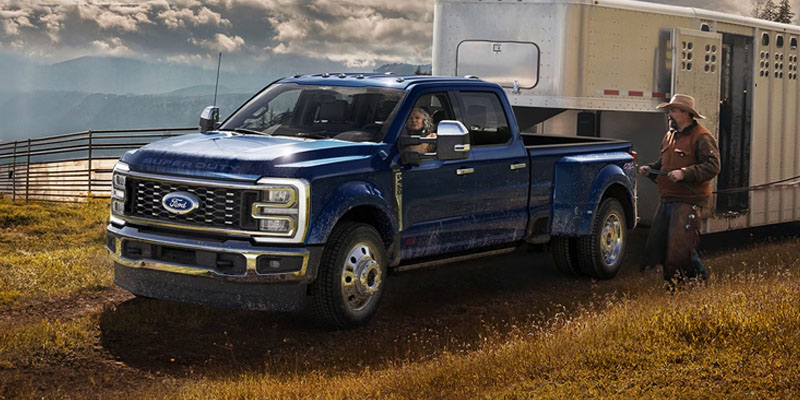
Understanding when a Super Duty truck makes sense requires looking beyond towing headlines and evaluating how heavy-duty systems change the way a truck behaves under real workloads.
What Actually Changes Between an F-150 and a Super Duty Truck
Many truck shoppers assume a Ford F-350 is simply a larger version of an F-150 with higher towing numbers. In reality, Ford Super Duty trucks are engineered around repeated heavy workloads rather than occasional towing alone.
A Ford F-150 is typically designed to balance:
- commuting comfort
- recreational towing
- lighter payload demands
- maneuverability
- everyday drivability
A Ford F-250 or F-350 is built differently because the truck is expected to manage larger trailers, heavier payloads, commercial hauling demands, and repeated towing stress over longer periods of time.
That changes how the truck functions mechanically. Super Duty models often use:
- heavier frame construction
- upgraded rear suspension systems
- larger braking components
- stronger axles
- higher-capacity cooling systems
Those systems work together to support heavier weight more consistently during towing and hauling situations.
For example, suspension behavior becomes increasingly important when trailer tongue weight or payload increases. Heavier-duty suspension systems help manage additional load while reducing instability, excessive squat, or trailer movement during:
- highway towing
- downhill braking
- uneven pavement
- longer-distance hauling
That is one reason many owners moving from an F-150 into a Super Duty platform describe larger trailers as feeling more controlled and less stressful while towing.
Why Payload Capacity Changes Truck Selection More Than Buyers Expect
One of the biggest areas of confusion for truck shoppers is the difference between towing capacity and payload capacity. Many buyers focus heavily on maximum towing ratings without realizing payload often becomes equally important depending on the trailer setup.
Payload refers to the amount of weight carried directly by the truck itself. That may include passengers, cargo, hitch equipment, tools, trailer tongue weight, or fifth-wheel pin weight.
This matters because larger trailers transfer part of their weight onto the truck. Even if a trailer technically falls within towing limits, payload limits may still become a factor once additional cargo and passengers are included.
For example, a fifth-wheel camper may place substantial vertical load directly into the truck bed. That additional load changes:
- suspension behavior
- braking stability
- rear axle stress
- steering feel
- overall towing balance
This is where a Ford F-350 often separates itself from a lighter-duty truck mechanically. Super Duty trucks use heavier-duty rear suspension systems and stronger payload structures because they are engineered to manage those loads repeatedly over time.
For many owners towing larger campers or enclosed trailers, payload support becomes one of the biggest reasons they eventually move into a heavy-duty truck platform.
When an F-350 Makes Sense for Real-World Towing and Hauling
Not every driver needs a Ford F-350, but certain towing and hauling situations may justify moving into a Super Duty category.
A heavy-duty truck may make more sense for drivers who regularly tow:
- large fifth-wheel campers
- equipment trailers
- horse trailers
- heavier enclosed trailers
- commercial loads
- agricultural equipment
Repeated towing changes truck demands significantly over time. A driver hauling heavier loads every week may place very different stress on the truck than someone towing a smaller camper only a few weekends each year.
This is where heavy-duty engineering becomes more noticeable in real-world use.
Ford Super Duty trucks are designed to maintain:
- suspension stability
- braking confidence
- drivetrain durability
- payload support
- trailer control
under repeated towing conditions.
Many drivers who regularly tow heavier trailers describe the difference less in terms of acceleration and more in terms of overall control. Larger trailers may create additional stress on the suspension, braking system, and rear axle behavior, especially during longer trips or highway towing situations.
For buyers consistently operating near heavier towing thresholds, a Ford F-350 may provide a more stable long-term towing platform.
Why Some Drivers Discover a Super Duty May Be More Truck Than They Need
At the same time, some buyers eventually realize a heavy-duty truck may not align with how they actually drive most of the time.
One recurring frustration across truck ownership discussions is discovering that maximum capability also changes daily usability. Compared to lighter-duty trucks, a Ford F-350 may feel different during normal driving because heavy-duty engineering affects:
- unloaded ride quality
- turning radius
- parking maneuverability
- steering feel
- overall truck size
For example, suspension systems designed to support heavier loads may ride firmer when the truck is unloaded. Larger dimensions may also become more noticeable during:
- city driving
- tighter parking situations
- parking garages
- residential neighborhoods
- drive-through lanes
That does not automatically make a Super Duty difficult to own. Many drivers use heavy-duty trucks daily without issue. But ownership experience often depends on:
- towing frequency
- driving environment
- commute distance
- parking needs
- family use
- overall workload consistency
A driver towing equipment every week may gladly accept those tradeoffs because the capability directly supports the workload. Meanwhile, someone towing recreationally only a few times per year may prioritize comfort, maneuverability, and easier commuting more heavily.
This is one reason truck fit often matters more than maximum capability alone.
What Truck Buyers Should Evaluate Before Choosing a Super Duty
Before moving into a Ford Super Duty truck, many buyers benefit from evaluating how the truck will realistically be used over time.
Important considerations may include:
- towing frequency
- trailer type and weight
- payload demands
- driving environment
- trip distance
- commercial versus recreational use
- future workload expectations
Occasional local towing may create very different truck demands than repeated interstate hauling or commercial trailer use. Truck capability is not only about what the vehicle can technically pull once. It is about how consistently the truck can manage:
- suspension load
- braking behavior
- payload stress
- towing stability
- long-distance control
over time.
For some drivers, an F-150 may still provide the best balance between towing support, comfort, maneuverability, and everyday driving practicality. For others, the added payload strength and towing stability of a Ford F-350 may better support long-term hauling demands.
The goal is not necessarily buying the biggest truck available. The goal is choosing the truck that realistically supports how the vehicle will be used most often.
Connect with us

